Sustainability
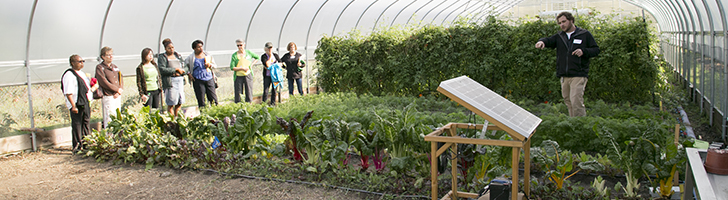
Oakland University is dedicated to being a campus of choice and sustainability is a core part of this initiative. A key element of sustainability is recycling — we are excited to roll out the OU RECYCLES campaign. OU uses single-stream recycling, which streamlines the collection process on campus. The recycling effort at OU ensures items that enter the waste stream will eventually be used to make other products for sale and reduce the need to use additional natural resources.
Green Buildings and Sustainable Design
The Fall 2013 semester saw the opening of Oakland University's first green building project, the geothermal/solar thermal Human Health Science Building. The HHB is Oakland's first geothermal heat pump installation, and it includes an innovative desiccant cooling system powered by one of the largest solar thermal energy system in the U.S. The building uses a newer form of technology, Variable Refrigerant Flow heat pumps. These heat pumps use variable speed compressors and serve multiple refrigerant zones per unit. OU was awarded a $2.75M U.S. Department of Energy grant to help fund this innovative green building concept.
University Energy Usage and Cost
Take a look at the historical usage and cost of the west campus utilities over the past decade. About $380 is spent each year per Full Year Equivalent Student (FY2010 data). This equates to about 4% of a full time student's tuition (based on 15 credit hours for two semesters).
Heating and Cooling Policy
Policy 300 Air Conditioning and Heating explicitly states that non-OU personal electric heaters are prohibited on campus. Electric heaters cover up HVAC issues, create fire hazards and consume SIGNIFICANT amounts of electricity. However, an innovative, controlled heater will be provided in cases where your area's HVAC cannot provide the proper heating. Please contact the Work Control Center at ext 2381 to report a problem or request a heater, or submit an on-line request.
Sustaining Our Planet Earth (SOPE)
Facilities and Grounds teams, including Director of Facility Services, Douglas LaLone and Assistant Director for Residential Facilities, Kevin McDougall, partnered with Sustaining Our Planet Earth (SOPE) and OU student Mustafa Baig, to put on a Campus Clean Up event!
SOPE is a University Housing led sustainability initiative seeking to make our campus community more sustainable, educate students and staff on sustainable practices, and enact sustainable plans and change for our University.
This Campus Clean Up event allowed for litter to be picked up around our campus, near our residential spaces, and the upper fields. Both students and staff joined SOPE in an effort to take responsibility for our campus, address the concern of improper trash disposal and to leave our university just as beautiful as we found it as we close out the school year.
It was a successful and enjoyable event for all involved and Facilities looks forward to partnering on future events!
Additional Campus Sustainability Efforts:
Recycling news and information:
The Detroit Free Press published an interesting article about recycling mistakes.
Tips for a Sustainable Summer
Many of us are excited to enjoy the outdoors and soak up the sun as it gets warmer. But it’s important to keep in mind that what we do during this season might have a big impact on the environment. We can make sure that our summer activities are not only entertaining but also environmentally responsible by making thoughtful decisions and adopting sustainable habits. Here are some pointers for being more environmentally friendly this summer:
Conserve Water: Water use tends to climb as temperatures rise. Reduce your water consumption by taking shorter showers, shutting off the water while you brush your teeth, and watering plants with a watering can rather than a hose. Gather rainfall and use it to hydrate your plants.
Choose Sustainable Transportation: When organizing summertime excursions, give cycling, walking, or public transportation serious consideration. To cut down on carbon emissions, carpool with friends or family if you’re going to the beach or a local park.
Pick eco-friendly picnic supplies: Summertime is synonymous with picnics and outdoor gatherings. Use reusable or biodegradable plates, cups, and silverware in place of single-use plastic alternatives. Bring a reusable water bottle along with your snacks so you can keep hydrated.
Embrace Sustainable BBQs: Summer is the ideal season for grilling, yet conventional charcoal grills can emit dangerous fumes. Consider buying a cleaner, more energy-efficient grill like one that is electric or propane. Use natural gas substitutes or charcoal that has been harvested sustainably.
Reduce Food Waste: Fresh fruits and vegetables are frequently in abundance during the summer. Use the farmers’ markets in your area or cultivate your own food. To reduce food waste, carefully plan your meals, and compost any organic waste you produce. Additionally, consider adding protein bars as a convenient and nutritious snack option to your summer meal planning.
Beach and Ocean Preservation: If you’re going to the beach, please consider its preservation. Avoid leaving trash behind and pick up after yourself. To protect your skin without endangering marine life, use sunscreen that is reef-safe. Take into account helping out at volunteer events for marine conservation groups or cleaning up local beaches.
Improve Energy Efficiency: People tend to use air conditioning more frequently as the days grow longer and hotter. To avoid the need for excessive cooling, set your thermostat to a moderate setting, utilize energy-efficient fans, and close your blinds or curtains during the hottest times of the day.
These straightforward suggestions can help you have a sustainable summer while leaving as little of an environmental footprint as possible. Keep in mind that sustainability is a way of life and that every small step counts toward a more sustainable and ethical future. Let’s make this summer a time for fun and environmental awareness!
Source: https://green.org/travel/tips-for-a-sustainable-summer/
The Sustainability Task Force challenges every OU staff and faculty member to pick at least one sustainable Earth Day practice to try this month. If you do, we'd love to see it! Send photos of your sustainable practice to fmhelp@oakland.edu.
What is stormwater?
Stormwater is the rainfall or snowmelt that flows over our yards, streets, parking lots, and buildings and either enters the storm drain system or runs directly into a lake or stream.
What is a storm drain?
Storm drains are the openings you see along curbs and in streets and parking lots. They carry away rainwater and snowmelt and transport it through the system to nearby lakes and streams. Water and other debris that enter storm drains do not go to a treatment facility.
What is a sanitary sewer?
A sanitary sewer takes household water and waste from toilets, sinks and showers, and transports it to a wastewater treatment facility. There, the water is treated and then discharged back to a lake or stream.
How does stormwater get polluted?
As stormwater flows over our lawns and driveways, it picks up fertilizers, oil, chemicals, grass clippings, litter, pet waste, and anything else in its path. The storm drain system then transports these pollutants, now in the water, to local lakes and streams. Anything that goes into a storm drain eventually ends up in a lake or stream.
In Michigan, communities are coming together to address stormwater management on a watershed basis. In the Clinton River watershed, seven subwatershed planning groups have formed: Upper Clinton, Clinton Main, Stony/Paint, North Branch, Red Run, Clinton River East, and Lake St. Clair Direct Drainage.
Stormwater pollution has become the predominant source of water quality and habitat impairments in the Clinton River and its tributaries. Under Phase II of the National Pollutant Discharge Elimination System (NPDES), part of the Clean Water Act, more than 40 local and county governments and numerous other public entities across the watershed must meet federal and state standards for reducing stormwater pollution leaving their jurisdiction.
Each group has charted a course to fulfill the requirements of their stormwater permits by working together on a subwatershed basis, sharing data and information and creating joint planning documents.
Oakland University is located inside the Clinton Main subwatershed.
Additional information regarding Oakland University's Stormwater Management program can be found at the Office of Environmental Health and Safety website.
Facilities Management
411 Pioneer Drive
Rochester, MI 48309-4482
(location map)
Siraj Khan
Associate Vice President for Facilities Management
Oakland University
Rochester, Michigan 48309-4401
(248) 370-2160