‘A remarkable project’
Study led by OUWB M4 sheds light on high-risk group of children who have type-1 diabetes and celiac disease
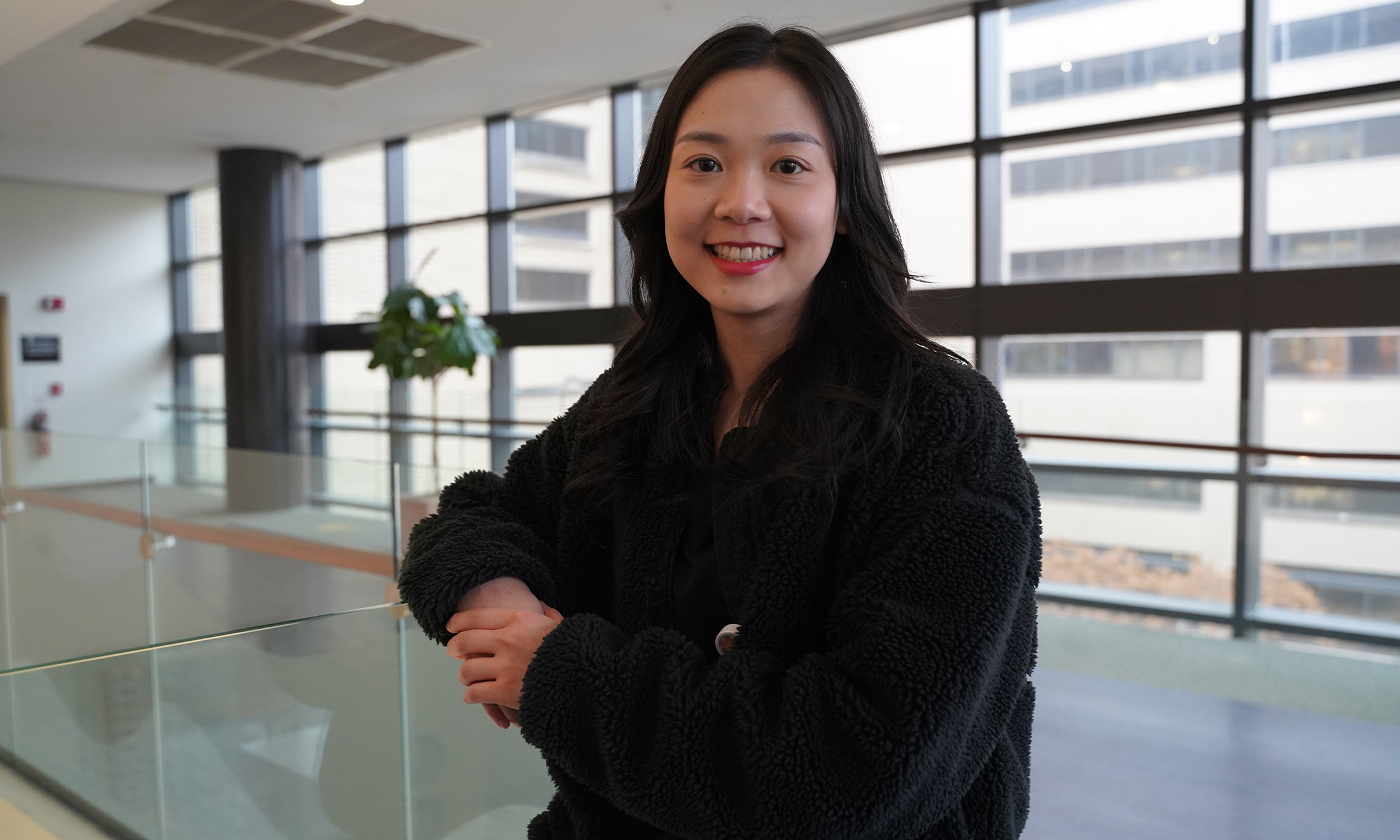
The first author was Amy Lin, a fourth-year medical student at OUWB.
Research
 March 20, 2026
 By Andrew Dietderich
Having both celiac disease and type-1 diabetes makes it significantly harder for children to manage their blood sugar, according to a recently published study led by an OUWB student.
“Association Between Celiac Disease and Uncontrolled Hemoglobin A1c Levels in Type 1 Diabetes Pediatric Patients,” was published in Pediatric Diabetes.
The first author was Amy Lin, a fourth-year medical student at OUWB.
She led a team of researchers who examined thousands of medical records and identified a high-risk group of children who have both celiac disease (CD) and type-1 diabetes (T1D). They also point out the associated health issues, and the need for physicians and clinicians to develop specific treatment plans for such patients.
“I am happy and excited that my research has been accepted by a high-impact journal,” says Lin. “I feel like it’s a milestone in terms of my medical career.”
'A gap in knowledge’
Before starting at OUWB four years ago, Lin attended University of Wisconsin-Madison for undergraduate studies. While there, she was involved in research related to metabolism.
She did a post-bac fellowship at the National Institutes of Health where she concentrated on translational research related to autoimmune diseases in the realms of nutrition and metabolism.
“I’ve always been interested in nutrition, how nutrients affect the body and are metabolized and how (nutrition) impacts other disease processes,” says Lin.
A big appeal to attending OUWB was the ability to continue her research through the school’s Embark program.
Embark is a four-year longitudinal curriculum that consists of structured coursework in research design and implementation, compliance training, research communication, and scholarly presentation, with protected time to develop mentored projects in a wide-range of community and health-related settings.
Lin says she developed the idea for her research project when she realized “there’s a gap in knowledge in (T1D) and (CD).”
“Most of the research goes into Type-2 diabetes because it’s so common,” she says.
Clash of the diets
T1D is a condition where the body can’t make insulin, a hormone that controls blood sugar. Children with T1D must check their blood sugar often and take insulin daily. It’s also important that they monitor what they eat, especially carbohydrates.
CD is an autoimmune disease where eating gluten damages the gut. The only treatment is a strict gluten-free diet.
The problem, the study states, is that the two diets clash because the diabetes diet recommends low-glycemic foods, but many gluten-free processed foods are high-glycemic.
In short, the “clash” could lead to poor glycemic control and that, in turn, could cause myriad health problems: retinopathy, nephropathy, and/or neuropathy, just to name a few.
So, the research team led by Lin set out to determine just how prevalent the problem is in children.
Methodology and findings
Through OUWB’s affiliation with Corewell Health, the research team looked at medical records of more than 2,200 children with T1D. They found that about 4.6% of children with T1D also had CD.
They also compared blood sugar levels of children who only had T1D with those who had both T1D and CD.
Those with both diseases were much more likely to have uncontrolled diabetes (high blood sugar). Specifically, 89% of children with both conditions had uncontrolled diabetes compared with 74% of kids with only diabetes.
Taking into account factors like age, race, and sex, the team determined children with both T1D and CD were 2.5 times more likely to have poor blood sugar control.
The researchers also found that children diagnosed with diabetes at a younger age had a more difficult time controlling it. Further, they determined that Black children have significantly higher odds of poor blood sugar control, pointing to important racial disparities in health care.
Lin says the findings are especially important for the pediatric population because they add “a new lens into whether Celiac Disease really would affect patients with (T1D).”
The hope she says is that the work will help improve patient care because it identifies a specific high-risk population. This better understanding, adds Lin, could also help physicians and clinicians understand the need for more monitoring, more frequent checkups, and individualized care.
“I hope people take away that patients with (T1D and CD) do have an increased risk of poor glycemic control,” says Lin. “Physicians and clinicians do need to take extra time to understand the barriers because having dual diagnosis is really taxing for patients.”
‘A remarkable project’
The research was “truly a remarkable project,” says Ramin Homayouni, Ph.D., professor, Department of Foundational Medical Studies and founding director, Population Health Informatics, OUWB.
Homayouni was a co-author along with Michelle Jankowski, biostatistician, OUWB; Virginia Uhley, Ph.D., associate professor, Department of Foundational Medical Studies; Shirley Qu, former senior engineer, Data Analytics, Corewell Health; and Michael Brennan, D.O., endocrinologist and assistant professor, Department of Internal Medicine.
“(The project) highlights not only Amy's hard work and dedication to the research project, but also the value of the longitudinal Embark program that sets OUWB apart from other medical schools,” says Homayouni.
He also calls it a testament to the established infrastructure at OUWB that supports student research, from collaborations between faculty and Corewell Health, to administrative support from Embark directors and OUWB research office who help with navigating research compliance components, to statistical expertise dedicated to support Embark projects.
“It truly takes a village to succeed in research, but it all starts with the talents and motivation of our students,” adds Homayouni.
More from inMedicine