Teaching Symposium
Welcome to our yearly event where Teaching Excellence takes root—growing ideas, building community, and advancing learning.
Find golden guidance and inspiration in a community committed to evidence-based practices that foster student success and shape the learning experience. Engage with fellow educators in meaningful discussions, explore new teaching strategies, and cultivate lasting professional connections.
Rekindling Connection through Engagement, Belonging, and Deep Learning (May 8, 2026)
Keynote Speaker: Claire Major | The New Terms of Student Engagement: Why It Feels So Hard (and What Can Actually Help)
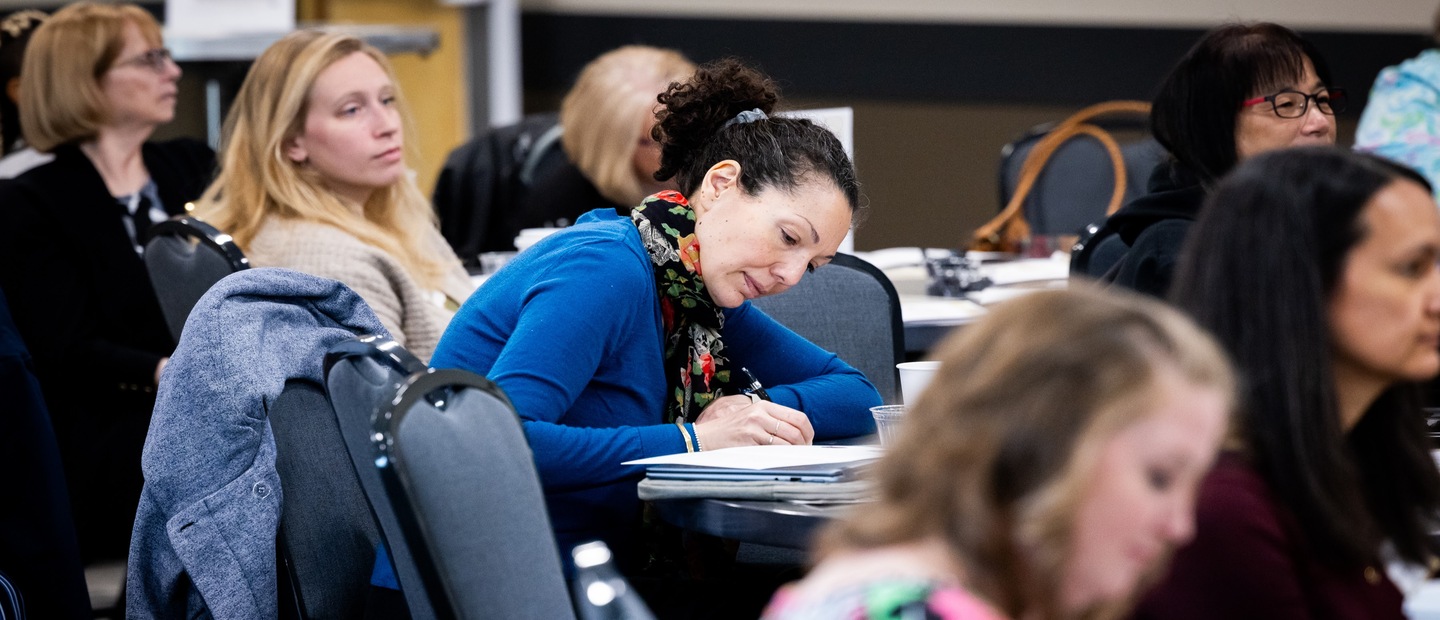
Our students arrive curious, capable, and eager for meaningful learning. This year’s symposium highlighted practices that met students where they were and built on their strengths—curiosity, diverse perspectives, and digital fluency—to foster deep, sustained engagement.
Colleagues from across campus and beyond came together to explore strategies that honored student potential, strengthened belonging, and created learning environments where all students felt empowered to participate and succeed.
View the symposium agenda, including full presentation abstracts and speaker biographies.
Watch symposium session recordings on YouTube, including keynote and presentation sessions, and access presenters' materials.
Dr. Claire Howell Major’s keynote, The New Terms of Student Engagement: Why It Feels So Hard (and What Can Actually Help), explored the shifting landscape of student engagement and the pressures instructors are experiencing in today’s learning environment. She examined the forces reshaping attention, motivation, and participation, and introduced a reframed model of engagement that highlights effort justification and cognitive investment. Her talk offered practical, research‑informed strategies to help faculty support meaningful engagement while maintaining their own well‑being. (Watch YouTube recording).
Dr. Major is a Distinguished Teaching Professor of Higher Education at the University of Alabama and Faculty Director of the UA Teaching Academy. Her scholarship focuses on instructional approaches and instructional technology, and she has authored eleven books and more than 40 journal articles. She has shared her work widely through national and international presentations and workshops, and she co‑founded the Cross Academy. Her career reflects a sustained commitment to teaching excellence and innovation in higher education.
AI in the Classroom: Empowering Student Vision without Losing the Human Touch
Generative AI acts as a "creative equalizer" in film education by removing technical and budgetary barriers to imaginative exploration. Students use these tools to prioritize directorial intent and storytelling depth while preserving their unique artistic voices.
Daewon Kim, Assistant Professor of Film Studies and Production (Department of English, Creative Writing, and Film)
AI in a Creative Classroom: Student and Audience Responses and Reflections
A case study of an undergraduate opera production demonstrates how AI tools can serve as ideation partners and rehearsal organizers under faculty mediation. The design emphasizes artistic discernment and clear authorship boundaries between human creators and technology to foster metacognitive awareness.
Drake Dantzler, Professor of Voice (School of Music, Theatre and Dance)
Bridging the Knowledge Gap: Using AI as a Cognitive Scaffold to Foster Deep Learning and Belonging in Cybersecurity
Generative AI serves as a cognitive scaffold to reduce inquiry fatigue and technical jargon overload in introductory technical courses. By separating AI-assisted research from core analytical reasoning, this model fosters a measurable boost in student belonging and objective mastery.
Amartya Sen, Associate Professor (Computer Science & Engineering)
Fashioning Critical Dispositions around Gen AI in the Digital Writing Classroom
Generative AI is positioned as an object of rhetorical and ethical inquiry rather than just a productivity tool. Students use analytic frames like power and justice to develop individualized techno-ethical frameworks and intervene in communication inequities.
Nick Sanders, Assistant Professor of Writing (Department of Writing and Rhetoric)
From Recall to Real Cases: AI-Integrated Exams that Produce Professionally Relevant Deliverables
Traditional exams are redesigned as AI-enabled, case-based evaluations where students use AI as an analytical partner. This model emphasizes the application of course concepts and critical evaluation of AI output through competency-based rubrics.
Douglas Carr, Professor and MPA Director (Political Science)
Learning with an AI Duck
The "protégé effect" allows students to learn by explaining concepts to an AI configured with a specific persona. Tools like Gemini and NotebookLM are used to limit AI knowledge, increasing its pedagogical value as an "explainee" or duck.
Kieran Mathieson, Associate Professor of Management Information Systems (Decision and Information Sciences)
Leading Cross-Border Innovation in Business Education: Implementing COIL between Legal Environment of Business and Consumer Behavior
Virtual collaboration between US and Mexico business students facilitates shared case analysis on ethical decision-making. This model provides global learning access to students who face financial or logistical barriers to traditional study abroad.Jennifer Cordon Thor - Professor of Management, Legal and Ethical Studies (Management and Marketing), & Agarzelim Alvarez-Milán - Professor of Marketing (Management and Marketing)
Building Accountability and Belonging through Weekly Study Logs and Collaborative Quizzes
Weekly study logs and collaborative quizzes improve student accountability and engagement in introductory statistics. These practices shift the focus from performance to a shared learning process where students take ownership of their habits and learn from each other.Ervisa Zhamo - Special Lecturer (Department of Mathematics and Statistics)
Anti-Oppressive Pedagogy in Action: Experiential Strategies for Inclusive Higher Education
An anti-oppressive, case-based teaching framework centers student strengths and identities to cultivate psychologically safe learning environments. Strategies include educator self-reflection on privilege and decentering dominant narratives through diverse and intersectional perspectives.
LaShauna Dean, Associate Professor in Counseling (University of the Cumberlands)
Self-Directed Mentorship: A Framework for Building Connected, Equitable, and Engaged Growth
This mentee-centered framework empowers individuals to diagnose their own needs and build personalized mentorship portfolios. By utilizing diverse resources across sectors and digital platforms, this model democratizes access to guidance and creates scalable growth pathways.
Changiz Mohiyeddini - Professor and Course Director (Department of Foundational Medical Studies)
Utilizing Debriefing Techniques for Teaching and Learning across Disciplines
Debriefing is a structured, bidirectional, self-reflective process designed to identify knowledge gaps and bridge theory with practice. Effective facilitators use these techniques across any discipline to optimize student growth through psychologically safe dialogue.
Lisa Daily - Simulation Nurse Educator (College of Nursing, Michigan State University) & Ashley Frost - Academic Specialist (The Learning and Assessment Center Simulation Lab, Michigan State University)
Moving Beyond "Welcoming": Cultivating Belonging through Inclusive Curriculum Design
A strategic course redesign shifts the environment from passive welcoming to active inclusivity through an audit of texts and example work. Faculty assume responsibility for inclusion by curating diverse perspectives that foster a genuine sense of student belonging and persistence.
Sheryl Ruszkiewicz, Special Lecturer (Department of Writing and Rhetoric)
Humanizing Practices to Support Identity Work in the Classroom
Humanizing practices support undergraduate students performing deep identity work and unlearning biases. Communal, reflective, and critical tasks lay the groundwork for a safe learning community conducive to personal growth before students enter their own future classrooms.
Danielle Ligocki - Associate Professor/Chair (Department of Teaching and Learning)
Belonging Through Annotation: Building Community and Critical Thinking in Online Courses
Social annotation via Perusall transforms reading from an isolated task into a collaborative, dialogic experience in asynchronous courses. This approach leverages student curiosity and digital fluency to strengthen peer connection and surface misconceptions early.
Megan Widman, Special Instructor (Sociology, Anthropology, Social Work, and Criminal Justice )
The Connected Classroom: A Framework for Building Belonging in Asynchronous Environments
Practical strategies like "Traffic Light" check-ins and "Micro-Communities" foster engagement in asynchronous online environments. These interventions transform an LMS into a psychologically safe space through a structured communication calendar and peer collaboration.
Hanna Kalmanovich-Cohen, Assistant Professor (Management)
From Awareness to Action: Building Resilient Learners through Trauma-sensitive/Resilience-Informed Practices
NEAR Science and trauma-sensitive strategies build a "culture of safety" that moves students out of survival mode and into learning. The framework also addresses secondary traumatic stress by helping educators develop personalized self-care plans.
Tomoko Wakabayashi - Professor and Chair (Human Development and Child Studies), Canequia Moulder - Graduate Student, Shawna Boomgaard - full-time faculty (Social Work, Oakland Community College)
The Case for Embedded Peer Mentors: Lessons and Reflections from the Embedded Writing Mentors in First-Year Writing Course
Undergraduate peer mentors in first-year writing build student confidence and belonging through relational practices. The program centers student-as-partner models to impact self-efficacy through trust, care, and navigational support.
Nick Sanders, Megan McCool - Assistant Professor (Writing and Rhetoric), Charlie Dawson - undergraduate student (English and Writing), Maria Mariotti, Shannon O’Connor - Embedded Writing Specialist , Dhara Bhakta
Analyzing AI-Generated Content: A Critical Thinking Framework for Evaluating Artificial Intelligence
A scaffolded critical thinking framework modeled on Lynch and Wolcott’s steps helps students progress in AI digital literacy. It focuses on the student perspective to move beyond simple cheating concerns and toward ethical, metacognitive evaluation.
Andrew Moser - Educational Development Specialist & Adjunct Instructor (Office of Teaching & Learning at Wayne State University), Christopher Susak
Designing for Digital Accessibility: From Remediation to Culture Change
Moving beyond reactive file remediation, this model explores how to embed accessibility into everyday workflows as a proactive culture shift. Participants learn to leverage tools like YuJa Panorama to make accessible design the default for all new content.
Nic Bongers - Director of Instructional Design (e-LIS)
Taking the Class out of the Classroom with Place-Based Education
Place-based education serves as a tool to improve student outcomes while strengthening the connection between students and the physical campus.
Tom Baranski, Christina Moore
From Probation to Connection: Building a Bridge for At-Risk First-Year Students
A proactive academic coaching program called GrizzFIRE provides high-impact intervention for first-year students on academic probation. By utilizing a cross-campus coalition of coaches, the initiative equips students with growth mindset and time management tools to increase retention.
Jessica Harrell - Director of the Academic Success Center (OU), Amy Gould - Student Success Program Manager (Academic Affairs)
Rekindling Purpose: The BIO Journey as a Pathway to Belonging and Growth
A cross-functional partnership between Biology and Career Services embeds career exploration directly into the academic discipline.
Kelly Dorner - Director of the Central Career and Life Design Center, Gerard Madlambayan - Professor and Chair (Biological Sciences), Denise McConkey
Concept Integration Framework for Co-Teaching Different Disciplines
The SHIFT framework increases the ease and efficiency of horizontally integrating topics across different disciplines.
Akshata Naik - Assistant Professor (OUWB), Jane Newman - Assistant Professor (Foundational Medical Studies, OUWB)
This symposium celebrates inclusive teaching and innovative practices that help students rediscover the joy and power of deep learning. Sponsorship ensures registration fees remain accessible while giving your department visibility across OU and external audiences. Your support helps sustain the event and reflects our shared commitment to engagement, belonging, and innovation.
Special thanks to our 2026 Teaching & Learning Symposium sponsors!
Principal Sponsor
School of Business Administration
Supporting Sponsors
e-Learning and Instructional Support
School of Nursing
College of Arts and Sciences
Contributing Sponsors
School of Education and Human Services
Graduate School
Departments and individuals can choose a sponsorship level from our Sponsoring Opportunities guide or make a custom contribution of any amount. Ready to support the symposium? Select a form below to get started.
The symposium has now concluded—thank you to everyone who participated. For those interested, the agenda remains available and includes full abstracts and detailed information about each presenter.
Missed a session or want to revisit your favorite talks? You can now watch recorded sessions on our official YouTube channel. Watch the sessions now.
Looking for slides, handouts, or other materials from the sessions? All resources provided by our speakers are available to view or download. Access the materials here.
Keynote Highlights:
- Dr. Todd D. Zakrajsek: Presented "Making Every Voice Count: Rethinking Engagement in Higher Ed," offering practical, research-informed strategies to foster inclusive participation. Emphasized the need to rethink classroom engagement by addressing barriers that prevent students—especially introverts and reflective thinkers—from contributing. Shared tools to build learning environments that support confidence, accessibility, and diverse forms of student interaction.
Faculty and Student Presentations:
- Forging Paths to Partnership - Exploring Ways to Deeper Faculty and Student Pedagogical Partnerships at OU - Cynthia Miree, Red Douglas, Payton Bucki, Dominique Hormillosa
- Engaging Student Learning with Public Service Announcement - Patricia Cameron
- Queering Curriculum: Integrating LGBTQ+ Perspectives into Teaching - Brie Desmond
- The Power of Stories: Transforming Composition I through Inclusive Storytelling and Creative Collaboration - Brittany Kelley
- Building Interactive Classrooms: Evidence-Based Strategies for Adaptive Learning and Real-World Skill Development - Sai Deepthi Yeddula
- Team Learning Outside and Inside: A Synergistic Approach to Student Engagement and Skill Development - Suzan Kamel-ElSayed
- Reviving Classroom Discussions with AI: Implementing Breakout Learning in ORG3310 - Hanna Kalmanovich-Cohen
- Starting College During COVID: Examining Whether Summer Bridge Programs Translate to a Remote Environment - VaNessa Thompson
- Reimagining Accreditation: Faculty-led Strategies for Moving Beyond Compliance - Virgina McMunn
- Eradicating Racism through Community-University Partnerships - Danielle Ligocki, Greg Bartley, Robert Martin, Chaunda Scott
- No Textbook Required: Converting courses to no-cost course materials - Julia Rodriguez
- From Static to Dynamic: Elevate Your Moodle Course with H5P - Nic Bongers
- Innovative Pathways to Inclusive Global Learning: Enhancing Accessibility and Intercultural Competence through COIL VE - Hana Moudallal
- Creating a Community of Learners through Reading - Greg Allar
- Data Talks: Evidence That Current Online Assessments Lack Integrity - Charlene Hayden
- Transparent Teaching in Three Simple Steps - Molly Gustafson
The 2024 symposium brought together teaching and research faculty, graduate students, and staff to explore strategies for fostering student connections with their community, classroom, and campus. The event featured engaging keynote presentations, insightful faculty talks, and discussions on inclusive and innovative teaching practices.
Keynote Highlights:
- Dr. Julie Dangremond Stanton: Shared research on metacognitive development and the academic experiences of underrepresented students in STEM.
- Birook Mekonnen: Discussed his work as a health services officer and contributions to public health emergency preparedness.
Faculty Presentations:
- How to Train Your Algorithm: Responsible AI in the Classroom — Dr. Bridget Kies
- Promoting College Readiness in Low-SES Learners — Dr. Kyeorda Kemp
- Interviews as a Learning Activity — Dr. Helena Riha
- Campus Farms: Teaching STEM Through Food and Farming — Dr. Fay Hansen
For recordings, session slides, and additional resources, view the Symposium Handout.
Over 70 people joined us throughout the day to reflect on teaching, learn about the engaging teaching work happening on our campus, and evaluating our assessment and grading practices. If you missed part or all of the day, or would like to revisit a talk or activity, look through our symposium handout, which includes links to a YouTube playlist of the day’s events plus resource documents and slides associated with each event.
Center for Excellence in Teaching and Learning
100 Library Drive
Rochester, Michigan 48309-4479
(location map)
(248) 370-2751
cetl@oakland.edu


Center for Excellence in Teaching and Learning
100 Library Drive
Rochester, Michigan 48309-4479
(location map)
(248) 370-2751
cetl@oakland.edu