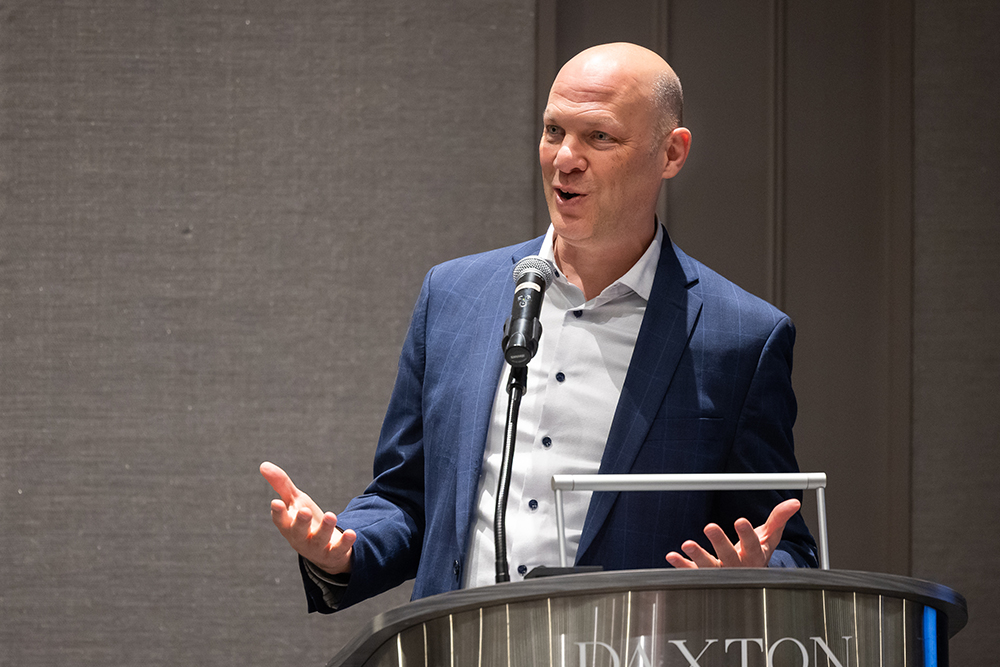
A top U.S. health law scholar recently spoke at an OUWB event to demystify an end-of-life option gaining a higher profile and being used by an increasing number of patients.
“VSED Increasingly Common Among End-of-Life Options: Top 10 Things You Need to Know,” was presented by Thaddeus Pope, J.D., Ph.D. at the Annual Krug Lecture in Biomedical Ethics. The event was held Nov. 12 at The Daxton Hotel in Birmingham. More than 100 people attended.
Pope is a professor at Mitchell Hamline School of Law in Minnesota and a fellow of The Hastings Center. He is a nationally recognized authority on medical law and clinical ethics with expertise in end-of-life decision making.
Pope presented the clinical, ethical, and legal status of VSED (voluntarily stopping eating and drinking). VSED is increasingly being considered as a treatment option by patients who wish to avoid living with late-stage dementia and other conditions they determine to be unbearable and unendurable.
“Hospices, hospitals, and other types of clinicians need to get ready for how they are going to respond when they have patients who ask about VSED,” Pope said after his presentation. “Patients are becoming more aware because an increasing number of books, films, webinars and so on are talking about VSED.”
Fear of dementia
“It’s time to get ready because you’re going to see more patients asking about it,” Pope said near the beginning of his lecture.
Pope first addressed the fear of dementia, and how it is “definitely at the top of the list” of motivators for VSED. (He noted that it’s not the lone reason for use of VSED.)
In talking about this fear, Pope underscored how widespread dementia is and that about 6 million Americans have Alzheimer’s and roughly another million have other dementias.
Pope said that dementia is the most feared condition in multiple surveys.
Because of such fears, Pope said some people want to take steps to avoid living with those conditions and seek ways to hasten death.
By law, medical assistance in dying (MAID) isn’t an option for those whose sole underlying condition is dementia. Two big reasons are that MAID requires a decision-making capacity and that patients have a terminal illness. With early dementia, the person doesn’t have terminal illness. With late-stage dementia, the patient lacks decision-making capacity.
That’s where the legal option of VSED comes into play for some patients, he explained.
VSED 101
 |
|---|
| Audience members had many questions for the lecturer. |
VSED is for patients who have the capacity to eat and drink by mouth but choose to stop with the intent to die from dehydration. The only requirement is capacity at the time of the decision and a voluntary, persistent choice to stop eating and drinking.
Pope explained that from a clinical perspective, VSED is validated, generally considered peaceful and comfortable when properly supported, widely practiced internationally, and professionally endorsed and guided by formal practice guidelines.
“We have more clinical experience with it, more professional society endorsements, and more clinical practice guidelines on how to do it,” he said.
VSED is legal, too, he said. Pope explained that people have a right to refuse any intervention, including food and fluids, and that force feeding against refusal is considered battery. He also said that clinicians who provide comfort care during VSED are not assisting suicide as defined by law. Further, statutes and regulations create safe harbors for withdrawing treatment and providing palliative care.
“There have been thousands and thousands of VSED deaths done in a very open and transparent way all across the country,” he said. “There is no evidence at all of any health care licensing board imposing discipline nor any criminal prosecution or any medical malpractice lawsuit ever being filed.”
Yet, VSED faces its fair share of ethical and clinical challenges.
For example, Pope said clinicians often feel there is a legal risk to VSED. Others are concerned about the possibility of clinicians introducing VSED and argue that it should only be patient-initiated. There’s also the issue of patients who appear to change their mind and how that should be handled. Further, hospice practices vary on how and when to enroll VSED patients. And because of the family and financial resources needed, VSED may not be as accessible to patients with fewer resources.
“There are challenges to be sure,” said Pope. “It’s still relatively new so there are both clinical and ethical questions.”
Attendee reaction
 |
|---|
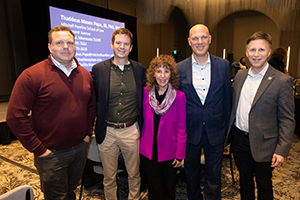
| From left, Wasserman, Mark Navin, Ph.D., professor and chair of Philosophy, OU, Ora Hirsch Pescovitz, M.D., president, OU, Pope, Christopher Carpenter, M.D., Stephan Sharf Dean, OUWB. |
Jason Wasserman, Ph.D., Dean’s Distinguished Professor, said Pope was a top choice to deliver the Krug lecture. He called the speaker “the leading health care law and ethics scholar in the country, arguably the world.”
“And we’re always looking for people who can both address complex and difficult topics but do it in a way that’s consumable for a diverse audience … they don’t need ethics expertise to understand what he’s talking about,” he said.
Wasserman said the topic of VSED is timely because “we’re increasingly confronting questions about end-of-life options as we extend the dying trajectory for patients with different technologies.”
“People are living longer, but they’re not necessarily living better at the end of their lives,” he said.
Students like M1 Rishabh Sud said he took away a lot from the lecture.
“Bioethics is something that will apply to all four years of medical school and beyond,” he said. “Hearing about end-of-life care was an interesting topic for me because I haven’t had much experience with it.”
Sud said he was particularly fascinated by how VSED laws and policies vary from place to place.
M1 Cassandra Vyazmensky said she also took note of how different countries and organizations view VSED and felt “there are not enough guidelines yet … there’s still a lot that’s up in the air” on the topic.
She also expressed appreciation for the ability to take advantage of such learning opportunities.
“As a medical student, it’s really important to be educated on different ethical topics … especially one like VSED, which is becoming more well-known to patients,” she said. “Learning about it and understanding the different perspectives was very important for me.”
For more information, contact Andrew Dietderich, senior marketing specialist, OUWB, at [email protected].
To request an interview, visit the OUWB Communications & Marketing webpage.
This work is licensed under a Creative Commons Attribution-NonCommercial 4.0 International License.