Electrical Engineering
Electrical engineering is a diverse field that spans various disciplines. Our Bachelor of Science in Engineering in Electrical Engineering program is crafted to equip students with the foundational knowledge and skills necessary for successful and challenging careers in this evolving field.
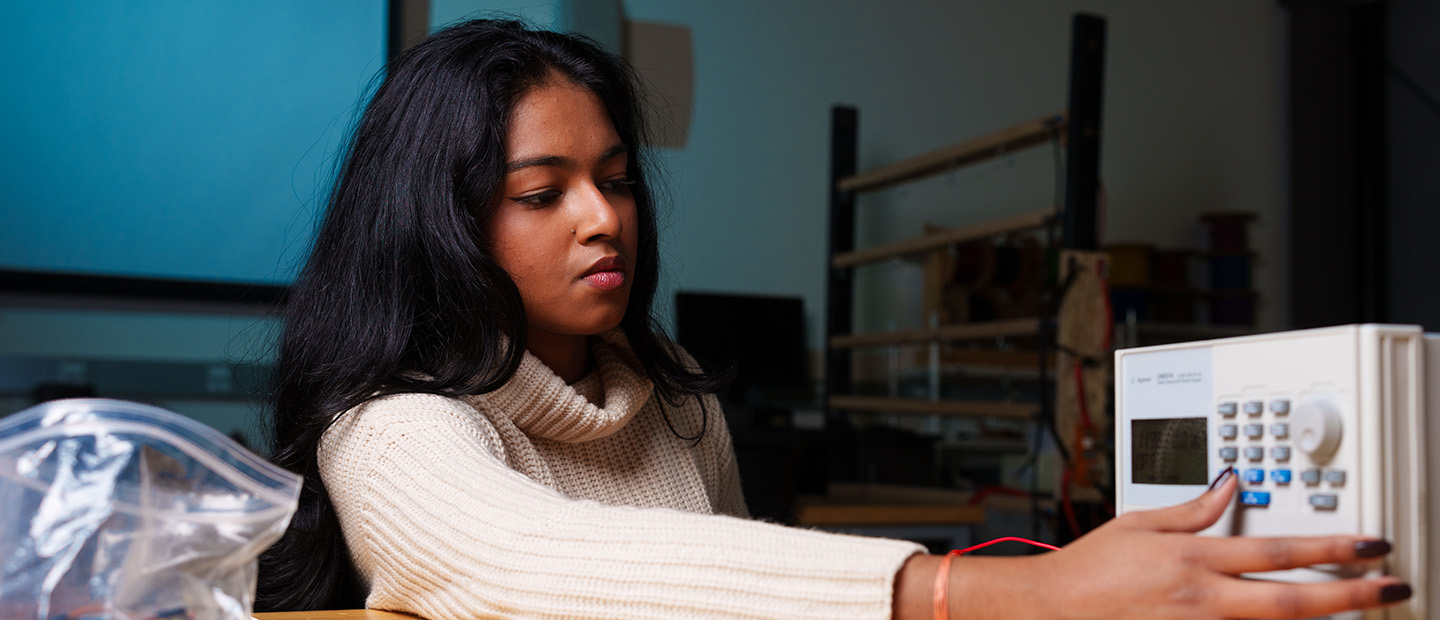
The curriculum covers essential areas such as analog and digital circuits, communications, computers, control systems, electromagnetics, electronics (including VLSI systems and electronic devices) and power systems. Complementing this strong theoretical foundation, the program features a robust laboratory component that offers numerous design opportunities. Students will engage with modern equipment and hardware/software tools to apply theoretical concepts to real-world problems.
Additionally, the program includes numerous engineering design experiences, ensuring that graduates are well-prepared to tackle the complex challenges of electrical engineering.
Program OverviewMajor RequirementsMinor Requirements
Concentrations
The Department of Electrical and Computer Engineering offers optional major-dependent concentrations to students interested in broadening their knowledge in a specific area and wishing to include this concentration in their degree. The concentrations are only available to students enrolled in the Bachelor of Science in Engineering degree in Electrical Engineering.
- Electrical Engineering, B.S.E., Concentration in Automotive Electrification
- Electrical Engineering, B.S.E., Concentration in Mechatronics
- Electrical Engineering, B.S.E., Concentration in Microelectronics
- Electrical Engineering, B.S.E., Concentration in Power and Energy Systems
- Electrical Engineering, B.S.E., Concentration in Robotics
Combined Programs
- Electrical Engineering B.S.E./Embedded Systems, M.S., Combined B.S.E./M.S.
- Electrical Engineering, B.S.E/Electrical and Computer Engineering, M.S., Combined B.S.E/M.S.
- Electrical Engineering, B.S.E/Mechatronics and Robotics Engineering, M.S. Combined B.S.E./M.S.
The B.S.E in Electrical Engineering program is accredited by the Engineering Accreditation Commission of ABET, https://www.abet.org, under the General Criteria and the Electrical Engineering Program Criteria.
Contact:
Brian K. Dean, Ph.D.
Associate Professor and Academic Programs Coordinator
Electrical and Computer Engineering Department
Oakland University, Rochester, MI 48309-4478
Office: (248) 370-2822
[email protected]
The B.S.E. in Electrical Engineering Educational Objectives are a set of skills that are necessary to function successfully in modern engineering practice.
The objectives of the Electrical Engineering program are to produce graduates who will:
- become successful practitioners in an engineering career or career requiring use of their engineering skills
- pursue graduate study, continuing education opportunities, and/or active participation in professional organizations in electrical engineering, computer engineering, mechatronics/robotics engineering, or other related disciplines
- demonstrate leadership and excel in multidisciplinary and multicultural environments
- function as responsible members of society with an awareness of the ethical, social, and environmental ramifications of their work.
Student Outcomes are a set of skills that assure the achievement of the program educational objectives. Before graduating, students will acquire the following key abilities:
- an ability to identify, formulate, and solve complex engineering problems by applying principles of engineering, science, and mathematics
- an ability to apply engineering design to produce solutions that meet specified needs with consideration of public health, safety, and welfare, as well as global, cultural, social, environmental, and economic factors
- an ability to communicate effectively with a range of audiences
- an ability to recognize ethical and professional responsibilities in engineering situations and make informed judgments, which must consider the impact of engineering solutions in global, economic, environmental, and societal contexts
- an ability to function effectively on a team whose members together provide leadership, create a collaborative environment, establish goals, plan tasks, and meet objectives
- an ability to develop and conduct appropriate experimentation, analyze and interpret data, and use engineering judgment to draw conclusions
- an ability to acquire and apply new knowledge as needed, using appropriate learning strategies.
School of Engineering and Computer Science
115 Library Drive
Rochester , MI 48309-4479
(location map)
Dean's Office (248) 370-2217
Academic Advising (248) 370-2201
[email protected]


School of Engineering and Computer Science
115 Library Drive
Rochester , MI 48309-4479
(location map)
Dean's Office (248) 370-2217
Academic Advising (248) 370-2201
[email protected]